With its comprehensive set of attributes, including uniform contact interfaces, low internal resistance, high energy density, exceptional magnification characteristics, and consistent expansion and deformation of the polar sheet, lamination has become a pivotal trend in the future of battery structure development.
In this article, we will delve deeper into the changes happening in the battery manufacturing industry and explore the possible trends that could shape its future.
Single-Machine Efficiency Improvement
Continuous improvement in single-machine efficiency is one of the most significant trends in laminated equipment. Currently, a single machine can produce up to 1GWh of laminated battery cells per year. However, technological advancements and process optimization are expected to push this limit even further in the coming years, with the capacity increasing to 2GWh, 4GWh, and even 8GWh. These improvements will lead to significant cost savings and production capacity enhancements for battery manufacturers.
Product Qualification Rate Improvement
Consistent production of high-quality battery cells is another critical aspect of laminated equipment. Currently, the product qualification rate for laminated battery cells is around 99%. However, with ongoing innovation and quality control measures, this rate is expected to rise significantly to 99.5%, 99.9%, and even 99.99% in the future. This improvement in product qualification will reduce the number of defective battery cells and ensure the production of reliable and high-performance batteries.
Improved Equipment Stability
Equipment stability plays a crucial role in the performance of laminated equipment. Currently, the mean time between failures (MTBF) for these machines is approximately 1,000 hours. However, with advancements in material science and engineering, it is anticipated that the MTBF will extend to thousands of hours in the future. This significant increase in equipment stability will result in reduced downtime, improved production efficiency, and lower maintenance costs.
Intelligent Integration
The future of laminated equipment is marked by greater integration and intelligence. Integrated processes, including die-cutting lamination and data-driven closed-loop intelligence, are set to become standard practices. These integrated systems will automate many manual tasks in the production of laminated battery cells, resulting in improved efficiency, reduced labor costs, and enhanced product quality.
Addressing Challenges: Burrs and Dust Control
While laminated equipment offers significant advantages for battery manufacturing, it also presents certain challenges. One of the primary issues is the generation of burrs and dust during the lamination process. These contaminants can negatively impact the quality and performance of battery cells, making it essential to develop effective control measures. Ongoing research and development efforts are focused on addressing this challenge through innovative material selection, process optimization, and dust collection systems.
Conclusion
In conclusion, the future of laminated equipment in battery manufacturing is bright, with promising trends in single-machine efficiency, product qualification rate, equipment stability, and intelligent integration. However, addressing the challenge of burrs and dust control will require continued innovation and technological advancement. As the battery manufacturing industry continues to evolve, laminated equipment will play an increasingly crucial role in producing high-quality, reliable, and cost-effective batteries for a wide range of applications.
]]>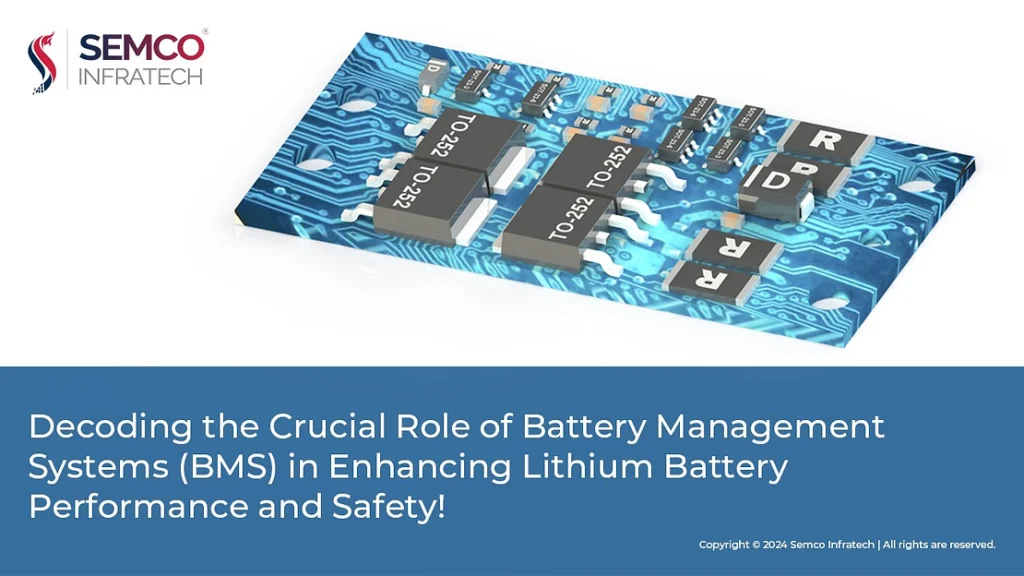
The Battery Management System (BMS) emerges as a critical electronic overseer for lithium batteries, meticulously monitoring voltage, current, temperature, SOC, and various parameters. Its role is pivotal in ensuring the optimal functioning and safety of lithium-ion batteries, particularly during charging and discharging cycles.
Why the Imperative Need for BMS in Lithium Batteries?
- Safety Imperatives:
Lithium batteries exhibit sensitivity, where even a single over-discharge can inflict irreversible harm. In extreme scenarios, overheating or overcharging may lead to catastrophic outcomes, such as thermal runaway, battery rupture, or explosions. The integration of BMS becomes indispensable to rigorously regulate the charging and discharging processes, mitigating risks of overcharging, over-discharging, and overheating.
- Functional Requirements:
Understanding the battery’s characteristics, especially the State of Charge (SOC) parameters, is crucial when employing lithium batteries. BMS not only predicts remaining battery power but also ensures real-time measurement of SOC, aligning with the diverse needs of customers.
- Addressing Inconsistencies in Large-Capacity Batteries:
Large-capacity lithium batteries often grapple with inconsistencies impacting their charge-discharge capabilities and overall lifespan. BMS steps in with its equalization capabilities, resolving these disparities and enhancing the overall performance of lithium batteries.
- Temperature Dynamics:
Batteries exhibit distinct performance at varying temperatures. The optimal operating temperature for lithium-ion batteries falls within the range of 25~40℃. BMS plays a pivotal role in controlling the ambient temperature during battery operation, mitigating adverse effects on SOC, open circuit voltage, internal resistance, available power, and overall battery service life.
- Understanding the Nature of Overcharge and Overdischarge:
The charging and discharging process involves the intercalation and deintercalation of lithium ions on the electrode plate. Overcharge can lead to the collapse of the positive electrode lattice, forming lithium dendrites that may damage the battery. On the flip side, over-discharge can diminish the activity of the positive electrode material, causing a sharp drop in battery capacity and potential structural damage.
Essential BMS Functions:
- Single cell voltage collection
- Single battery temperature collection
- Battery pack current detection
- Monomer/Battery SOC measurement and calculation
- Battery State of Health (SOH) evaluation
- Charge and discharge balancing function
- Insulation detection and leakage protection
- Thermal management control (cooling, heating)
- Key data records (cyclic data, alarm data)
- Battery failure analysis and online alarm
- Communication function (with chargers, motor controllers, etc.)
BMS Topologies:
Distributed: Functions are distributed to each battery, communicating with the main control through a bus.
- Advantages: Simple design, few connections, high reliability, easy expansion.
- Disadvantages: Requires a control board for each battery, cumbersome and costly installation.
Centralized: All functions are completed by the main control, directly connected to the battery through wires.
- Advantages: Simple design.
- Disadvantages: Involves long and numerous connections, low reliability, limited management of multiple batteries.
Modular: One master and multiple slaves structure, where functions are completed by the slave control.
- Advantages: No need for a control circuit board on each battery, flexible connection, easy expansion.
- Disadvantages: Requires consideration of communication isolation, diverse communication, and complex control.
Selecting the Ideal BMS:
- Prioritize stability and reliability.
- Align functions with customer needs.
- Evaluate factors such as voltage, temperature, current accuracy, SOC calculation, equalization function, thermal management, and fault alarms.
In essence, the Battery Management System (BMS) stands as the guardian of lithium batteries, ensuring their safety, performance, and longevity through meticulous monitoring and control mechanisms.
]]>In this article, we will delve into the various methods employed to assess and test lithium battery performance, covering essential aspects of capacity, cycle life, self-discharge, temperature characteristics, safety, and charging performance.
1. Battery Capacity Test
The battery capacity is a fundamental indicator of its performance. It measures the amount of charge it can store and subsequently deliver. Battery capacity evaluation is typically conducted through various testing methods:

Charging and Discharging Cycle Test: Involves repeated cycles of charging and discharging the battery to assess its capacity over time.
Constant Current Discharge Test: The battery is discharged at a constant current to determine its capacity.
Constant Power Discharge Test: Similar to the constant current discharge method, but the battery is discharged at a constant power.
2. Cycle Life Test
The cycle life of a battery refers to the number of charge and discharge cycles it can endure under specific conditions. Cycle life testing is essential to evaluate a battery’s longevity.
3. Self-Discharge Test
Batteries tend to lose charge over time without being used, a phenomenon known as self-discharge. This performance aspect is measured by monitoring the voltage change in the battery after it’s left unused for a certain duration.
4. Temperature Characteristic Test
Temperature is a significant factor influencing battery performance. Batteries often operate in varying temperature conditions. Testing the temperature characteristics of a battery involves charging and discharging at different temperatures to assess its performance under such conditions.
5. Safety Test
Safety is paramount when evaluating battery performance. Rigorous safety tests, including overcharge, over-discharge, and short-circuit tests, help assess a battery’s reliability under adverse conditions. These tests are crucial in preventing accidents and ensuring user safety.
6. Charging Performance Test
Charging performance is a vital aspect of a battery’s operation. It encompasses parameters like charging efficiency and charging rate. To evaluate these aspects, testing methods such as charging efficiency testing and charging rate testing are employed.
Choosing the Right Evaluation Methods
The specific evaluation and testing methods applied depend on the unique needs and circumstances surrounding the battery in question. Different applications may necessitate specific tests to ensure optimal performance and safety.
These testing methods are the cornerstone of ensuring that lithium batteries meet the high standards expected in today’s technologically driven world. Accurate evaluations not only guarantee top-notch performance but also prioritize the safety of users, making lithium batteries a dependable and essential part of our daily lives.
]]>Why We Need a BMS:
Secondary batteries, the workhorses powering most of our gadgets, have some inherent weaknesses. They have limited storage capacity, a finite lifespan, and are prone to issues when connected in series or parallel. Plus, accurately gauging their remaining power can be tricky. This is where the BMS steps in, acting as the bridge between the battery and the user.
What Does a BMS Do?
Think of a BMS as a battery’s guardian angel. Its primary functions are:
1. Monitoring the Battery’s Health:
Based on these parameters, the BMS judges the battery’s current state and takes necessary actions to prevent overcharging or over-discharging, ensuring its optimal performance and longevity.
2. Managing Charge and Discharge:
The BMS acts as a traffic controller, regulating the battery’s charging and discharging processes. It considers environmental factors, battery health, and other variables to determine the optimal charging or discharging curves, ensuring smooth and efficient power delivery.
3. Maintaining Cell Balance:
In a battery pack, individual cells can have slight variations in capacity and discharge rates. The BMS acts as a leveler, using active or passive balancing techniques to ensure each cell charges and discharges at the same pace. This prevents overstressed cells and extends the overall lifespan of the battery pack.
Inside the BMS Toolbox:
The BMS is no magic box, but a clever combination of hardware and software working together:
1. Signal Acquisition Module: This gathers vital data like voltage, current, and temperature from the battery pack, providing the BMS with real-time insights.
2. Battery Protection Circuit Module: Think of this as the safety switch. It uses software to control external devices like relays, cutting off power or preventing charging/discharging when the battery reaches unsafe levels.
3. Balance Circuit Module: This dedicated circuit monitors individual cell voltages and orchestrates the balancing act, ensuring all cells stay in sync.
4. Lower Computer Module: This is the BMS’s brain, processing the collected data, making decisions, and controlling the other modules to optimize battery performance and safety.
The Future of BMS:
As technology advances, BMSs are becoming increasingly sophisticated, incorporating features like wireless communication, cloud-based monitoring, and predictive maintenance. This allows for real-time data analysis and remote battery management, ensuring even longer battery life and safer operation.
]]>In this article, we will delve into a practical example of such checks, specifically focusing on the flange bolts of a module and the bottom of the output aluminum row.
Module Flange Bolt Installation Stress Check
The module’s structural integrity relies on the secure installation of its components, including flange bolts. In this example, four M6 studs are employed on each end plate of the module. The prescribed locking torque is set at 15+/-2N.m, with an upper limit of 17 for verification. To ensure safety, the torque is converted to a preload of 1467N.
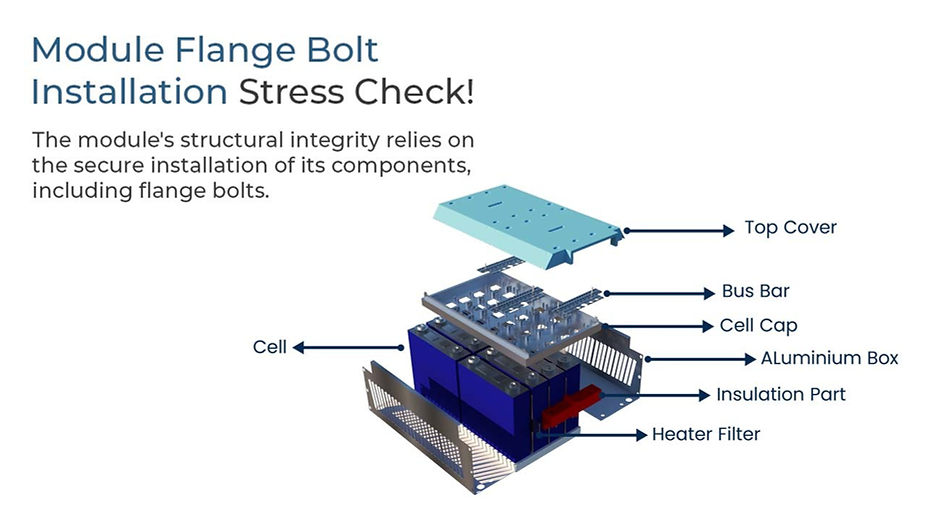
The first step is to measure the diameter of the flange surface, which is found to be 13.6mm, and the diameter of the end plate hole, measuring 8.2mm. With these measurements, we can calculate the pressing area (S) as follows: S = 3.14 x (6.8^2 – 4.1^2) = 92.4mm².
Now, we can calculate the stress applied to the end plate using the formula P = F/S = 14167/92.4/10^6 = 153.3Mpa. Considering the yield strength of the 6063-T6 material, which can be adjusted to 220Mpa, we find that 153.3Mpa comfortably meets the requirements, ensuring the structural integrity of the module.
Stress Check at the Bottom of the Output Aluminum Row
Similar to the flange bolts on the module, M6 flange surface bolts are used in this scenario. The prescribed locking torque is 13, which is converted to a preload of 10833N. The compression area is determined to be 103mm². Calculating the stress, we find P = F/S = 89Mpa. Comparing this value with the yield strength of the nickel sheet, which is 185Mpa, we can confirm that the stress levels are within acceptable limits, ensuring the reliability of the assembly.
Additional Tests and Considerations
In addition to torque and stress checks, there are several other critical tests and procedures that should be carried out during the battery pack assembly process. These include:
Insulation and Voltage Testing: Ensuring the insulation integrity and voltage levels within the pack are within safe limits.
Installation Torque Record: Recording and verifying the torque applied to various components for future reference.
Air Tightness Test of Liquid Cooling System: Checking for any leaks in the liquid cooling
system to prevent coolant loss.
Air Tightness Test of Battery Box: Ensuring that the battery box is sealed properly to prevent dust and moisture ingress.
Capacity Test: Verifying that the battery pack’s capacity matches the design specifications.
Adjusting the Shipment SOC: Setting the state-of-charge to an appropriate level for shipping and storage.
Brushing Software: Configuring the battery management system (BMS) software for optimal performance.
OCV Test: Conducting open circuit voltage tests to verify the pack’s voltage levels.
Weighing the Battery Pack: Measuring the weight of the fully assembled battery pack for documentation and transportation purposes.
The case study presented here emphasizes the importance of rigorous torque and stress checks in ensuring the reliability and safety of new energy battery packs. By following precise measurement and calculation procedures, manufacturers can confidently confirm that their battery modules and components are assembled to meet industry standards. Moreover, the implementation of additional tests and quality control measures further enhances the overall performance and safety of these critical energy storage systems.
]]>A square battery consists of chemical components enclosed in a rigid shell, and its rectangular shape allows for the efficient stacking of multiple units within the battery module. There are two types of square batteries: stacked and flat. Stacked square batteries can release more energy at once, providing superior performance for the same volume, while flat square batteries contain more energy and offer greater durability.
Square batteries are primarily utilized in energy storage systems and electric vehicles due to their larger size, making them unsuitable for smaller devices such as electric bicycles and mobile phones. As a result, they are better suited for energy-intensive applications.
Cylindrical batteries are enclosed in rigid cylindrical cans and are small, round, and stackable in devices of various sizes. Their shape prevents expansion, a phenomenon caused by the concentration of gas volume in the battery shell, which is undesirable.
Initially used in laptops with three to nine batteries, cylindrical batteries gained popularity when Tesla incorporated them into its first electric vehicles (Roadster and Model S), each containing 6,000 to 9,000 batteries.
These batteries are also utilized in electric bicycles, medical equipment, and satellites. Their shape is crucial for space exploration, as other cell forms would deform under atmospheric pressure. For instance, the latest rover sent to Mars operates with a cylindrical battery, and the E-Formula high-performance electric car uses the same battery as the rover in its battery.
Is Shape the Difference?
The differences between square and cylindrical cells extend beyond their shape. Other important distinctions include size, the number of electrical connections, and power output.
Size: Square batteries are significantly larger than cylindrical batteries, containing more energy. For instance, a single square battery can hold the same energy as 20 to 100 cylindrical batteries. The smaller size of cylindrical batteries makes them suitable for applications requiring less power, leading to a wider range of uses.
Connection: Due to their larger size, square batteries require fewer units to achieve the same energy output, resulting in fewer welded electrical connections. This minimizes the risk of manufacturing defects, a significant advantage of square batteries.
Energy: While cylindrical batteries may store less energy than square batteries, they have greater power output. This means that cylindrical batteries can release energy faster, making them ideal for high-performance applications. On the other hand, square batteries are optimal for maximizing energy efficiency.
High-performance battery applications such as E-Formula racing cars and Ingenuity helicopters on Mars require exceptional performance in extreme environments.

Why can square batteries be replaced?
The electric vehicle industry is evolving rapidly, and the dominance of square or cylindrical batteries remains uncertain. Currently, cylindrical batteries are more prevalent, but there are indications that square batteries will gain popularity.
Square batteries offer cost-saving opportunities by streamlining the manufacturing process. Their format allows for the production of larger batteries, reducing the number of electrical connections that require cleaning and welding.
Additionally, square batteries are an ideal form of lithium iron phosphate (LFP) chemistry, which utilizes a cheaper and more accessible material mixture. Unlike other chemicals, LFP batteries use resources found all over the earth and do not require rare and expensive materials like nickel and cobalt, which drive up the cost of other battery types.
There are strong indications of the emergence of LFP square cells. In Asia, electric vehicle manufacturers are already using LiFePO4 batteries, which are square LFP batteries. Tesla has also announced the use of Chinese-made square batteries in the standard range version of its cars.
However, LFP chemistry has significant drawbacks. It contains less energy than other chemicals currently used, making it unsuitable for high-performance vehicles such as Formula One electric vehicles. Additionally, the battery management system (BMS) faces challenges in predicting the battery’s charging level.
Square batteries in the energy storage system
When it comes to battery pack production demand, energy storage systems (ESS) are just as crucial as electric vehicles. ESS already utilizes square batteries and is likely to continue doing so. Square batteries offer a longer cycle life, lower risk, and reduced cost compared to cylindrical batteries.
Tesla’s 4680 cylindrical cell, with its desktop cell design, high energy density, and low manufacturing cost, is currently one of the most remarkable batteries. However, Tesla has recently started using them in some models.
While the 4680 cylindrical batteries have yet to be replaced by a square battery, Tesla’s next move will determine the future. Will they replace the 4680 nickel-cobalt-aluminum oxide (NCA) chemistry with LFP chemistry? If so, they will transition to square batteries. Considering the rise in global raw material costs, this is a strong possibility.
Conclusion
Despite their similar function, square and cylindrical batteries differ in key ways beyond shape. Cylindrical reign supreme, but square batteries offer cost advantages and excel with LFP chemistry, ideal for energy storage.
However, LFP limitations in high-performance applications keep the future open. Tesla’s square battery shift and potential LFP adoption could reshape the industry. As energy storage needs rise, choosing between square and cylindrical will significantly impact the battery landscape.
]]>