From Raw Materials to Electrode
The journey starts with a precise blend of materials. Enormous mixing machines, resembling industrial-sized blenders, combine positive and negative materials (such as lithium cobalt oxide and graphite) with electrolytes and other components. Ball mills, similar to giant metal tumblers, crush these raw materials into fine powder, maximizing their surface area for optimal energy storage.
Next, the magic of coating equipment takes the spotlight. Picture a high-tech printer, delicately spreading the slurry of materials onto thin copper or aluminum foils. These coated foils, transformed into electrode sheets, are the heart of the battery, ready to be assembled. But before that, drying ovens step in, evaporating any remaining solvents and leaving behind a ready-to-use electrode layer.

Assembling the Battery Symphony
With the electrodes ready, the assembly line comes to life. Battery shell assembly equipment, precise as clockwork, layers these electrodes with separators, creating the core battery units. Stacking machines meticulously stack these layers while winding machines gracefully roll them into compact cylinders or pouches.
From individual monomers to formidable packs, battery module assembly equipment takes over. Think intricate robotic arms, seamlessly connecting these single units into larger, higher-capacity configurations. Finally, battery packaging equipment steps in, hermetically sealing the whole ensemble, ensuring safety and leak-proof performance.
Testing: Quality Assured, Performance Uncompromised
Every power pack undergoes rigorous testing before leaving the factory. Capacity test equipment meticulously measures the amount of energy a battery can hold and deliver, while charge and discharge performance test systems put its charging and discharging capabilities through rigorous paces. Aging test equipment, simulating years of use in a matter of days, ensures long-lasting performance and identifies potential weaknesses.
Automation: The Rhythm of Efficiency
Modern lithium-ion battery production is a symphony of coordinated movements. Industrial robots, the tireless conductors of this orchestra, deftly maneuver components, perform delicate welds, and conduct quality checks with unwavering precision. Automatic conveying systems, akin to conveyor belts on steroids, seamlessly transport batteries between processes, eliminating bottlenecks and maximizing production efficiency.
Sustainable Power, Beyond the Cradle
The story doesn’t end with a fully charged battery. As these powerhouses reach their end
of life, responsible recycling takes center stage. Battery disassembly equipment carefully dismantles spent batteries, separating casings from precious materials like lithium and cobalt. These recovered materials, courtesy of battery material recovery equipment, get a second lease on life, reborn into new batteries, closing the loop and promoting a sustainable future.

The Numbers Game: A Glimpse into the Scale
The lithium-ion battery industry is a behemoth, projected to reach a staggering $96.7 billion by 2025. A single electric vehicle battery pack can require over 6,000 individual lithium-ion cells, each meticulously crafted by this intricate ballet of equipment. And behind it all, a workforce of over 730,000 people toils tirelessly, ensuring the uninterrupted flow of these energy powerhouses.
Beyond the Equipment: The Human Touch
But the magic of lithium-ion battery production goes beyond the machines. It’s the tireless engineers who push the boundaries of technology, the meticulous technicians who ensure precision at every step, and the researchers who relentlessly seek new materials and processes. This human ingenuity, coupled with the relentless hum of specialized equipment, is what truly powers the future, one lithium-ion battery at a time.
As we move towards a cleaner, more sustainable energy future, lithium-ion batteries and the sophisticated equipment behind them will remain at the forefront. Understanding their intricate dance is not just an engineering marvel; it’s a glimpse into the future, where powerful, portable energy empowers every aspect of our lives. So, the next time you reach for your phone, remember the countless gears, robots, and human minds that orchestrated its seemingly effortless charge. It’s a testament to the ingenuity of our time, a symphony of technology powering a brighter, more sustainable tomorrow.
_____________________________________________________________________
About Semco – Established in 2006, Semco Infratech has secured itself as the number 1 lithium-ion battery assembling and testing solutions provider in the country. Settled in New Delhi, Semco provides turnkey solutions for lithium-ion battery assembling and precision testing with an emphasis on Research and Development to foster imaginative, future-proof products for end users.
For More Updates Follow Us
WhatsApp – Facebook – Instagram – Twitter – LinkedIn – YouTube
]]>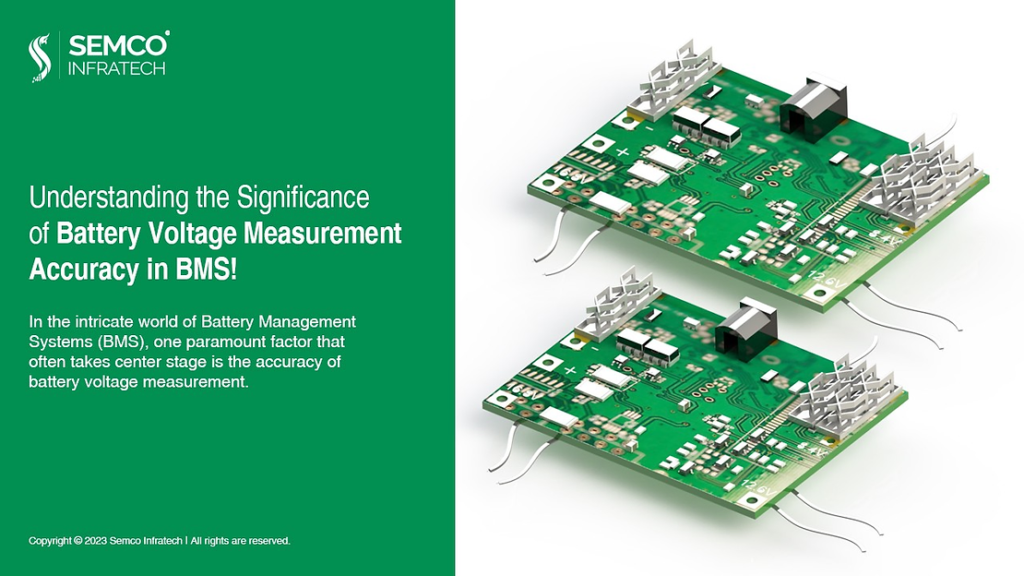
In the intricate world of Battery Management Systems (BMS), one paramount factor that often takes center stage is the accuracy of battery voltage measurement. This seemingly technical parameter plays a pivotal role in determining the estimation error of a battery’s State of Charge (SoC).
But what exactly is SoC, and why is it essential?
Let’s unravel the intricacies by considering lithium iron phosphate batteries as a prime example. These batteries exhibit a specific correlation between their Open Circuit Voltage (OCV) and SoC. To understand this, one needs to recognize the non-linear nature of the OCV-SoC curve. This curve depicts the relationship between the OCV of lithium iron phosphate batteries and their corresponding SoC.
As the battery undergoes discharging, internal chemical reactions lead to a gradual reduction in the OCV. Conversely, during the charging process, these reactions elevate the internal electrochemical potential energy of the battery, resulting in an OCV increase.
The OCV-SoC curve takes on a distinctive shape, with steep voltage changes between SoC values of 0-20% and 80-100%. In contrast, the voltage shift is more gradual between SoC values of 20-80%.
This curve forms the basis for the Open Circuit Voltage method employed in practical applications to estimate SoC. It relies on measuring the battery’s OCV. However, the accuracy of this estimation hinges on the precision of voltage measurements. A minuscule 1-millivolt (1mV) fluctuation in OCV can translate to a substantial 5% variation in SoC. This relationship is depicted in Figure 2, where you can observe how the change rate of each millivolt of voltage corresponds to different SoC values in the case of a typical lithium iron phosphate battery.
In practical terms, this signifies that if your voltage measurement is accurate to within 1mV, your SoC estimation will have an accuracy of approximately 5%. Furthermore, the change rate of each millivolt voltage corresponding to SoC differs for various charge states, thereby affecting SoC estimation accuracy across different charge states.
It’s important to note that the discussion thus far pertains to the influence of voltage measurement accuracy solely when the OCV method is used for SoC estimation. In practice, other factors, such as discharge rate and operating temperature, also affect
SoC estimation accuracy. To enhance accuracy, SoC estimation methods often employ a combination of approaches, including the ampere integral method, advanced techniques like Kalman filtering, or even cutting-edge deep learning AI algorithms.
As battery technology continues to evolve, precise voltage measurement remains integral to ensuring optimal SoC estimation, contributing to the efficiency and performance of various applications, from portable electronics to electric vehicles and renewable energy systems. Accurate voltage measurement enables intelligent BMS to optimize battery performance and enhance overall system reliability.
_____________________________________________________________________
About Semco – Established in 2006, Semco Infratech has secured itself as the number 1 lithium-ion battery assembling and testing solutions provider in the country. Settled in New Delhi, Semco provides turnkey solutions for lithium-ion battery assembling and precision testing with an emphasis on Research and Development to foster imaginative, future-proof products for end users.
For More Updates Follow Us
WhatsApp – Facebook – Instagram – Twitter – LinkedIn – YouTube
]]>
The variation in lithium battery parameters, such as capacity, internal resistance, and open circuit voltage, is mainly due to inconsistencies. These inconsistencies occur during production and worsen over time.
Definition of Consistency
Currently, Cell Consistency in Lithium Battery Assembly means bringing together important characteristic parameters of a group of batteries. It’s a relative concept, with no “most consistent,” only “more consistent.” Ideally, each parameter in multiple cell strings within the same pack should stay within a small range for consistency.
When considering time, consistency involves maintaining all characteristic parameters throughout the entire life cycle of all cells in the pack. This helps reduce capacity reduction inconsistency, internal resistance growth inconsistency, and aging rate inconsistency. Ultimately, the focus is on ensuring consistency for the entire pack’s lifespan.
The Concept of Inconsistency
The inconsistency of lithium battery parameters mainly involves capacity, internal resistance, and open circuit voltage. The voltage represents the initial battery voltage during assembly, while internal resistance is the AC internal resistance when fully charged, and capacity is the discharge capacity after full charging.
As the battery undergoes continuous charge and discharge cycles, the state of each individual cell (SOC, voltage, etc.) becomes increasingly different. Additionally, the varying usage environment within the lithium battery pack affects each cell differently.
This gradual amplification of inconsistency during use can accelerate the performance degradation of some cells and eventually lead to premature failure of lithium battery packs.
Note: SOC refers to the remaining power of the battery and is an important parameter for battery use. It is used to estimate the overcharge and over-discharge of the battery.
Causes of Inconsistency
The inconsistency of lithium battery packs is a gradual process. Over time, the differences between individual batteries within the pack increase. Additionally, the battery pack is influenced by its usage environment. As time goes on, the inconsistencies among individual batteries are amplified, leading to accelerated performance degradation of some batteries and eventual failure of the entire pack.
The inconsistency of lithium battery packs is primarily influenced by two factors:
1. Technical issues and uneven materials during manufacturing result in small differences between battery materials. After the pack is put into use, variations in electrolyte density, temperature, ventilation conditions, self-discharge rate, and charging/discharging processes may lead to differences in capacity and internal resistance among batteries from the same batch.
2. When used in a vehicle, factors such as electrolyte density, temperature, ventilation conditions, self-discharge rate, and charging/discharging processes of each battery within the pack can also impact consistency.
Scope of Evaluation of Consistency
My understanding is that the consistency of all cells is crucial, whether they are in series or parallel. Here’s a simple example:
In a parallel setup, if cells with low discharge capacity (let’s call them B) are connected in parallel with other normal cells to form a module D, they can become a bottleneck in the entire battery pack’s discharge capacity over time due to faster aging.
In a series setup, if a module D in the whole battery pack has aged more than other modules, it can affect the entire pack’s charging process and lead to imbalances in capacity and internal resistance.
Therefore, ensuring consistency across all power batteries is essential, not just within individual modules.
Hazards and Problems Caused by the Inconsistency of Lithium Battery Packs:
Poor consistency can lead to uneven real-time voltage distribution during charging and discharging, potentially causing overvoltage charging or under-voltage discharge, which poses safety risks.
Here are the details:
- Capacity loss: The capacity of the weakest cell determines the capacity of the entire battery pack, following the “barrel principle.”
- Life loss: Cells with lower capacity may reach the end of their lifespan sooner due to excessive output during each cycle, affecting the entire group of cells they are connected to.
- Increased internal resistance: Cells with higher internal resistance generate more heat, leading to accelerated deterioration and further increase in internal resistance.
- Lithium batteries use a protective circuit system to ensure safety. Voltage consistency is crucial, as the protection system relies on voltage monitoring. If one cell reaches protection conditions, the battery circuit is cut off, regardless of the status of other cells. Over time, differences in voltage consistency can lead to loss of battery value and potential safety issues, especially if there are individual protection system failures.
_____________________________________________________________________
About Semco – Established in 2006, Semco Infratech has secured itself as the number 1 lithium-ion battery assembling and testing solutions provider in the country. Settled in New Delhi, Semco provides turnkey solutions for lithium-ion battery assembling and precision testing with an emphasis on Research and Development to foster imaginative, future-proof products for end users.
For More Updates Follow Us
WhatsApp – Facebook – Instagram – Twitter – LinkedIn – YouTube
]]>